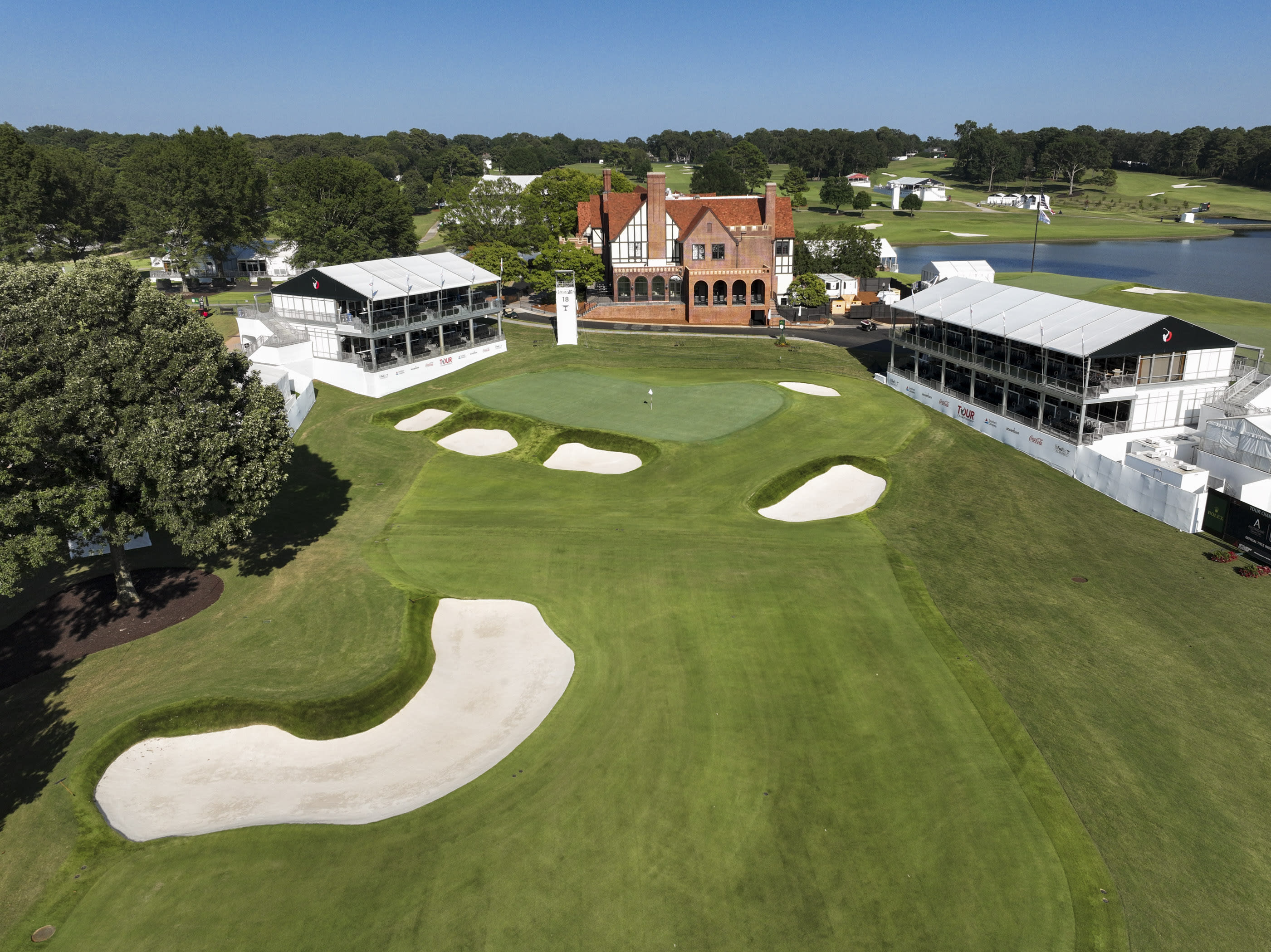
The Card
- Venue: The Cliffs at Walnut Cove
- Where: Asheville, North Carolina, USA
- Architect: Jack Nicklaus
- Scorecard: Par 71, 7,249 yards
That is the complete set of course details on record for this week. Fairway width, green size, grass types, stimp and water holes are not recorded for The Cliffs at Walnut Cove, so anything written about them here would be guesswork. The scorecard itself is the firm ground: a Nicklaus design at 7,249 yards to a par of 71, hosting a 128-player field on the PGA Tour schedule from September 17, 2026.
The read: Build off the scorecard and the hole mix this week, because the setup detail that usually shapes a course model is not available.
What Kind Of Test This Is
No course metrics were found on any version of this venue, which means there are no difficulty percentiles to work from: no measure of how the scoring average, the driving test or the green complexes rank against the rest of the schedule. That is a genuine blank rather than a soft one, and it is worth saying plainly before anyone leans on a course-fit narrative that has no numbers underneath it.
What can be said comes from the card. Par 71 at 7,249 yards is not a short number in isolation, and the hole mix leans heavily on the par 3s in a way most venues do not. Beyond that, the honest position is that this is an unmeasured test.
The read: Treat course-fit reads on this venue as low confidence and weight recent form and baseline ball-striking instead.
The Holes
The mix is unusual: five par 3s, nine par 4s and four par 5s. Five one-shotters is a full hole more than the standard allocation, and they are not short ones, averaging 212 yards. A par 3 that long is closer to a long-iron or hybrid approach than a scoring hole, and there are five of them.
The par 4s average 445 yards and span 409 to 481 yards, so there is no drive-and-flick hole among them and no genuine monster either. The facts also list four par 4s measuring between 360 and 450 yards, which puts a cluster of the two-shotters in the mid range rather than at the top of the span. The four par 5s average 545 yards, a length that invites the longer half of the field to go at them in two.
No hole scoring averages are available, so the hardest and easiest holes cannot be identified. What the yardages suggest is a course where the scoring chances are concentrated in the par 5s and the damage is spread across five long par 3s.
The read: Long-iron proficiency carries unusual weight here on volume alone, with four par 5s as the counterweight for the bombers.
Courses It Resembles
There are no comparable venues on record for The Cliffs at Walnut Cove, and with no course metrics to match against, there is no defensible way to name one. The card alone puts it in the company of long par 71s with an extra par 3, but that is a description rather than a comp.
The read: Without a comp set, course-history-by-proxy angles do not hold up this week.
What It Took To Win
No past winners are on record for any version of this course, and no stat correlations exist either, so there is no evidence about which part of the game has carried a champion here. The strongest available signal remains the scorecard: five par 3s at an average of 212 yards, nine par 4s averaging 445, and four par 5s averaging 545.
The read: With no winner profile to lean on, the defensible lineup build is straight ball-striking form rather than a specialist angle the data cannot support.