The Card
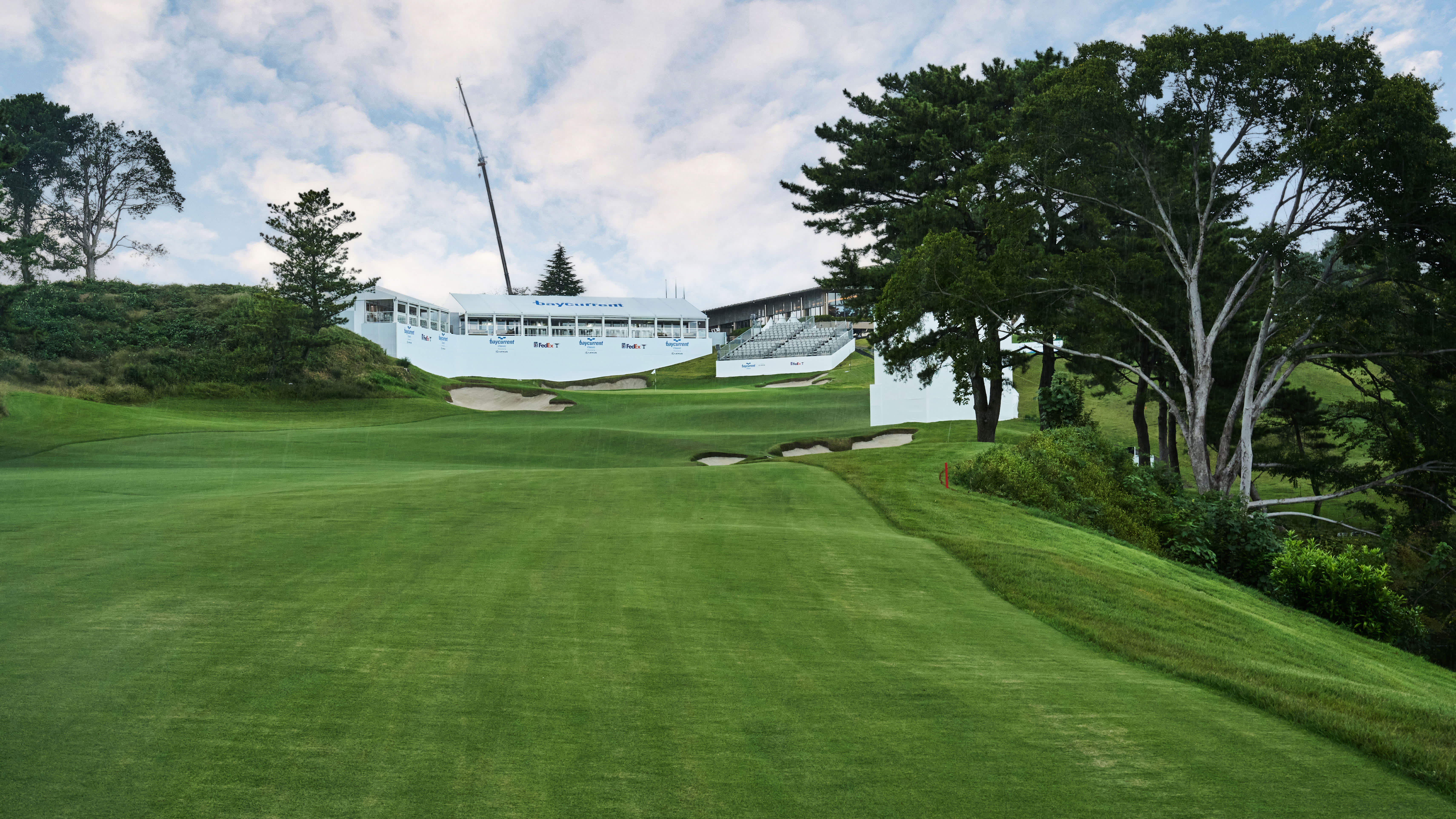
- Venue: Yokohama Country Club
- Where: Yokohama, JPN
- Architect: Takeo Aiyama\Hideo Takemura
- Scorecard: Par 71, 7,322 yards
- Fairways: Zoysia
- Rough: Zoysia, 3.15 inches
- Greens: Bentgrass, running 11.5 on the stimp
The Baycurrent Classic returns to Yokohama Country Club on October 8, 2026, with a 72-player field. Par 71 over 7,322 yards is not long by modern standards, and the 3.15 inches of zoysia rough is the obvious counterweight to that.
One important caveat before any of the numbers below: Yokohama has a single running on record, from 2025. Everything that follows is indicative rather than settled.
The read: Treat this as a lightly sketched venue, not a mapped one, and size positions accordingly.
What Kind Of Test This Is
The headline from 2025 is that the course gave up fairways. Driving accuracy came in at 67.9%, one of the easiest marks on record, and the field hit 65.1% of greens in regulation, right around tour average. Scoring followed: a 23.0% birdie-or-better rate was easier than average and the 15.8% bogey-or-worse rate sat in the middle of the pack.
The sting was in the misses. The penalty for missing the fairway was 0.43, which ranked 35th hardest of the 191 courses measured for it, and the penalty for missing the green was 0.78, 48th hardest. That is a venue where the fairway is findable but the zoysia rough charges real money when it is not found.
Scrambling at 59.2% was easier than average, which cuts slightly against the recovery penalty above. The fair reading is that short-side trouble was costly without being severe.
The read: Scoring was available in 2025, so this profiles as a birdie-hunting week rather than a survival one.
The Holes
The mix is 3 par 3s, 13 par 4s and 2 par 5s, a par-71 layout tilted heavily toward the two-shotters. Par 4s stretch from 337 to 510 yards, with 6 of them sitting in the 360 to 450 band. The par 3s average 195 yards and the par 5s average 532.
The two long par 4s on the back nine did the damage. Hole 14 at 508 yards played 0.301 over par and hole 11 at 510 yards played 0.205 over, with the 237-yard 16th at 0.196 over completing the trio.
The scoring came from the par 5s. Hole 6 at 529 yards played 0.667 under par and hole 4 at 536 played 0.535 under, both short enough to be reachable for most of this field. The 387-yard 15th at 0.17 under was the only par 4 of note on the giving side.
The read: With only two par 5s and both of them soft, converting those two holes is close to mandatory for a winning number.
Where Strokes Are Won And Lost
One skill separated itself in 2025. Adjusted off-the-tee strokes gained over the prior nine months tracked scoring at 0.421 here against 0.219 tour-wide, a gap of +0.202. That is the only positive gap in the file, measured across roughly 65 players, and it fits the course shape: findable fairways, a stiff penalty for missing them, and a set of 500-yard par 4s on the back nine.
Everything on the approach side moved the other way. Adjusted approach form over the prior eight weeks ran at a gap of -0.249, greens in regulation at -0.315, proximity to the hole at -0.240 and fairway proximity at -0.251. Long approach form was no help either, with proximity from 200-plus yards at -0.202 and from 50 to 75 yards at -0.300. None of that means iron play was irrelevant, only that it separated the field less here than it does at a normal stop.
Around the green and on the greens, the same pattern held. Scrambling proximity came in at a gap of -0.210 and putting from 5 to 10 feet at -0.229. Recent birdie rate (-0.219) and recent bogey avoidance (-0.190) also failed to travel, and even adjusted total strokes gained over the prior eight weeks carried a gap of -0.187, which suggests short-term form generally mattered less here than it usually does.
The counter-argument deserves stating plainly: these are correlations from one tournament of roughly 51 to 65 players, so the negative gaps are better read as an absence of signal than as proof that approach play did not matter. The positive driving number is the one finding with any weight behind it.
The read: Lean on nine-month off-the-tee numbers and discount hot eight-week form more than usual.
Courses It Resembles
The measured comparisons are a mixed bag by reputation but consistent on scale. The Cliffs at Walnut Cove (par 71, 7,249 yards) and Jack Nicklaus Golf Club Korea (par 72, 7,344 yards) both come in at 91.6% similar, with Liberty National Golf Club (par 71, 7,410 yards) at 90.4%.
Behind them sit The Concession Golf Club (par 72, 7,564 yards) at 89.7% and TPC Twin Cities (par 71, 7,431 yards) at 87.2%. The common thread is length in the low-to-mid 7,000s rather than any shared architectural style, and most of the group plays to a lower par than a standard 72.
The read: Course-history buys are best sourced from Liberty National and TPC Twin Cities form, which share both the par and the yardage band.
What It Took To Win
There is one champion on record. Xander Schauffele won here in 2025 at 19 under par, a total that reinforces how available scoring was in that running.
The strokes gained breakdown for that week is not recorded, so there is no way to say which department carried him. That is a genuine hole in the brief rather than a judgement call, and it leaves the off-the-tee gap as the only skill evidence available.
The read: With a 19-under winning score and a single data point behind it, price in a low number and build around drivers rather than grinders.