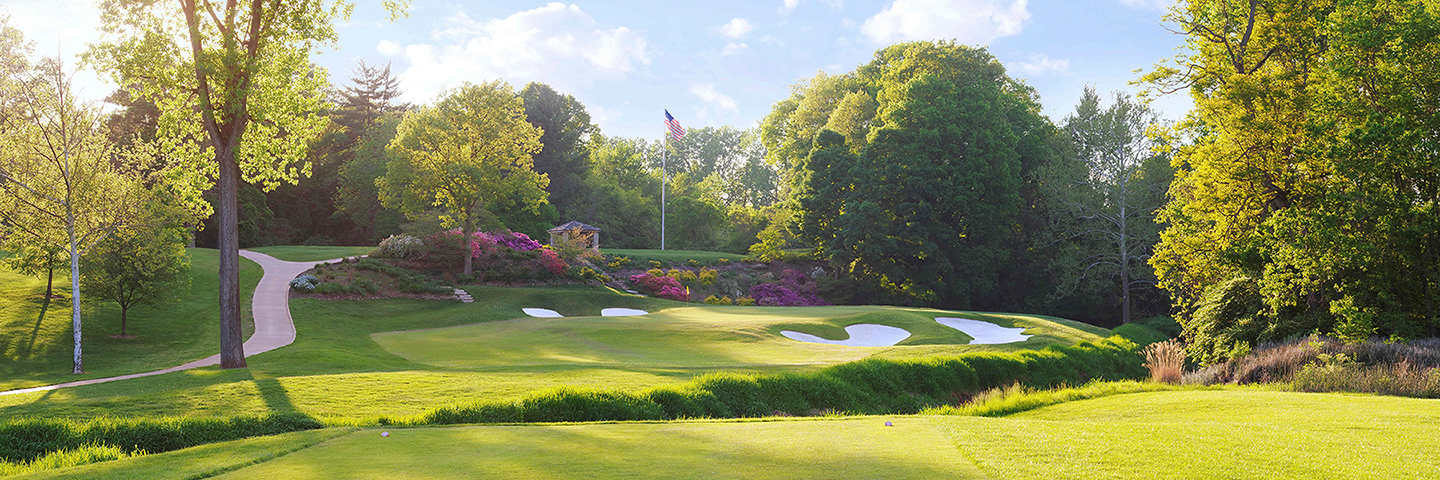
The Card
- Venue: Bellerive Country Club
- Where: St. Louis, Missouri, USA
- Architect: Robert Trent Jones, Sr.
- Scorecard: Par 70, 7,448 yards
- Fairways: Zoysia
- Rough: Fescue, 3 inches
- Greens: Bentgrass
The setup has changed since the tour was last here. Bellerive played to 7,316 yards at par 70 in 2018; this week it is stretched to 7,448 yards at the same par. That is a different card at the same address, and the course record resets accordingly.
The read: Par 70 at 7,448 yards with only two par 5s means birdie chances are rationed, so target scores should be set lower than a typical August week.
What Kind Of Test This Is
The difficulty profile here is thin and old. It comes from a single running, the 2018 event, and that is eight seasons before this week, so treat every figure below as indicative of what Bellerive was rather than a settled read on what it is.
In 2018 the venue graded harder than average in the ways that matter most for scoring. Birdie-or-better rate sat at 17.6%, which ranked 45th hardest of 189 courses on record, and bogey-or-worse came in at 19.2%, 60th hardest. Scrambling was 54.1%, again on the difficult side of the ledger at 65th of 189.
The counter-argument is real: driving accuracy in 2018 was 65.5%, which ranked 149th of 189 and made this one of the easier courses to hit fairways on. Greens in regulation at 64.7% was ordinary. This was not a course that beat players up on ball-striking volume; it beat them up on converting.
The read: Based on 2018, this profiled as a low-birdie, moderate-bogey grind, so lean toward steady scorers over volatile ones and expect a winning number well short of a birdie-fest.
The Holes
The par mix is the story: 4 par 3s, 12 par 4s and just 2 par 5s. Those par 3s average 202 yards, the par 4s average 450 and the two par 5s average 618. Long par 3s and a dozen par 4s is a lot of holes where par is a good result.
The par 4s are not uniform. They stretch from 361 to 514 yards, and six of them measure between 360 and 450 yards, which the facts confirm directly. That gives the card a genuine split between wedge holes and holes that play as long two-shotters.
The hardest holes back that up. Hole 6, a 215-yard par 3, played 0.351 over par. Hole 4 at 514 yards played 0.309 over, and Hole 10 at 510 yards played 0.285 over. The relief comes from the two par 5s: Hole 8 at 613 yards gave up 0.306 under par and Hole 17 at 624 yards played 0.26 under, with the 361-yard Hole 11 at 0.24 under par.
The read: The scoring holes are the two par 5s and a short par 4, so a player who cannot reach 613 and 624 yards in two is giving away the only cheap strokes on the property.
Where Strokes Are Won And Lost
Off the tee, the 2018 numbers pulled in two directions. Fairways were relatively findable at 65.5% accuracy, ranking 149th hardest of 189, but the cost of missing them was steep: a 0.41 penalty for missing the fairway, 50th hardest on record. The penalty for lack of distance was 0.17, right around tour average at 90th, so length was useful without being decisive.
Approach play graded as ordinary by proximity, 35.5 feet and 123rd of 189, with greens in regulation at 64.7% and 70th. Neither number screams difficulty. What they do suggest is that the field found greens at a normal clip and simply did not get close enough, often enough, to make birdies at a normal rate.
Around the green, the picture is again split. Missing a green cost 0.67 in 2018, which ranked 157th of 189 and made recoveries comparatively cheap, yet scrambling still only converted at 54.1%, 65th hardest. Putting was flat across the board: 87.3% made inside 10 feet, 14.9% made outside 10 feet, both sitting near the middle of the sample.
The read: The 2018 data points at approach quality and fairway avoidance of the 3-inch fescue as the separators, not putting, so weight ball-striking models over hot-putter narratives.
Courses It Resembles
The measured comps cluster tightly around the same shape. Glen Oaks Club is the closest at 90.0% similar (par 70, 7,346 yards), followed by Ridgewood CC at 87.6% (par 71, 7,385 yards) and Caves Valley Golf Club at 86.8% (par 70, 7,601 yards). Bethpage Black comes in at 86.0% (par 70, 7,352 yards) and TPC Four Seasons Resort at 85.6% (par 70, 7,166 yards).
Most of these are par 70 tracks in the 7,100 to 7,600 range, which is the same skeleton Bellerive presents this week. That is a set of long, tree-framed, low-par venues where the field is asked to make pars on two-shotters and take what the par 5s offer.
Worth noting that the comps are drawn from measured profile rather than reputation, so the resemblance is statistical. Caves Valley in particular has produced very different scoring conditions to Bethpage Black despite landing near each other here.
The read: Course history models should pull from the par 70 comps above rather than from generic August form, with Glen Oaks the tightest single reference point.
What It Took To Win
There is one data point, and it is a good one. Brooks Koepka won here in 2018 at 16 under par with a complete week: 1.469 off the tee, 1.472 on approach, 1.015 putting, and minus 0.005 around the green. His strongest area was approach, by the narrowest of margins over driving.
The around-the-green figure is the one to sit with. Koepka was effectively neutral there and still won by a clear margin, which fits a venue where missing the green cost only 0.67 in 2018. He gained heavily in the three areas that produce looks at birdie and converted them.
One winner is not a pattern, and the setup has changed by 132 yards since. Still, the shape of that week lines up with what the difficulty metrics said: find fairways, hit quality approaches, and the short game becomes a footnote.
The read: The only winning line on record was built on approach and driving with a neutral short game, which argues for prioritising tee-to-green gainers over scramblers when building the card.